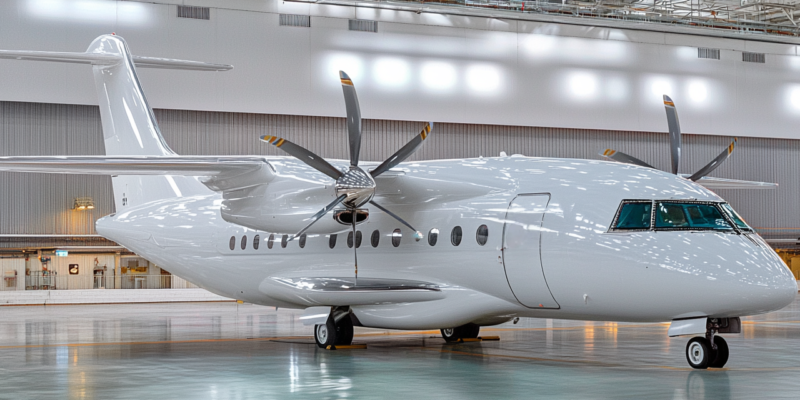
Regional aviation has had a challenging 2025. While global networks rebound, many short-haul and regional routes remain economically fragile, particularly across Europe and the UK. The recent collapse of Eastern Airways and Blue Islands serves as a reminder of how vulnerable smaller carriers are to the twin pressures of high operating costs and shifting market expectations. The forthcoming introduction of the D328eco by Deutsche Aircraft represents a welcome intervention and one that could redefine how regional connectivity is delivered in a lower-carbon, cost-sensitive world.
A modern evolution of a proven airframe
The D328eco is a new-generation turboprop aircraft derived from the Dornier 328, a platform with a strong reputation for reliability and short take-off and landing performance. While retaining the core aerodynamic DNA of its predecessor, the D328eco incorporates extensive updates: a stretched fuselage, new Pratt & Whitney Canada PW127XT engines, advanced avionics, and a flight deck designed for single-pilot operation capability in the future.
Critically, the aircraft is optimised for Sustainable Aviation Fuel (SAF) from day one, with provision for future hybrid-electric propulsion integration. This makes it one of the few aircraft in its category that has been designed around both current and future environmental standards, rather than adapted to them. With its 40-seat configuration, the D328eco aims to offer the efficiency of a turboprop with the comfort and performance expected from a regional jet.
Addressing the regional reality
For regional carriers, the challenge has never been purely technical. It lies in achieving sustainable economics on routes that are essential for regional connectivity but often marginal in profitability. Many of these routes are too short for jet efficiency yet too thin in demand for larger turboprops. This is the space Deutsche Aircraft intends to occupy.
The D328eco can hold cruise speeds of up to 600 km/h, with a range of around 2,000 km, and the ability to operate from short or unpaved runways, which positions it perfectly for secondary and tertiary airports. This could help reverse the gradual decline of direct regional air links that have disappeared in recent years as airlines leaned to larger aircraft or withdrew altogether.
Additionally, the aircraft’s reduced fuel burn and lower maintenance complexity directly address the cost structures that have forced many regional carriers to the brink. A key factor behind Eastern Airways’ difficulties was a combination of small fleet size, high per-seat costs, and exposure to volatile fuel prices on routes with limited yield potential. The D328eco, if operated in the right network context, has the potential to alleviate some of those pressures by lowering the trip cost rather than the seat cost, making thinner routes viable again.
Enabling a new generation of regional operators
The D328eco is also arriving at a time when public service obligation (PSO) routes and decentralised air mobility initiatives are under renewed scrutiny. Regional governments and airport authorities increasingly view air connectivity as an enabler of economic balance, not merely a commercial service. A modern, lower-emission, right-sized aircraft provides the kind of operational credibility that could attract new entrants and partnerships under these frameworks.
For established carriers, the type could serve as an efficient replacement for ageing 30–50 seat fleets such as the Saab 340 or Jetstream 41; aircraft that are increasingly expensive to maintain and non-compliant with future emissions targets.
Sustainability with pragmatism
Deutsche Aircraft’s positioning of the D328eco is pragmatic. Rather than promising revolutionary propulsion overnight, it focuses on tangible, certifiable improvements that can deliver immediate emissions reductions of up to 40% compared with comparable regional jets. Its compatibility with up to 100% SAF means operators can integrate sustainability targets without significant infrastructure change.
In an era where environmental credibility is becoming a condition of market access, particularly within Europe’s evolving regulatory environment ,this could prove to be a major differentiator.
A cautiously optimistic outlook
The D328eco will not, by itself, solve the challenges of regional aviation. Success will depend on how operators structure networks, manage fleet use, and work with regulators to maintain vital air links. But it does represent a meaningful step towards a more sustainable and economically rational model for short-haul flying.
Where the regional market has long been caught between ambition and affordability, the D328eco offers something rare: a modern aircraft designed not just for where aviation has been, but for where it needs to go.